Klaus M. Schmidt

Chair's Message

Dear Members of the Verein für Socialpolitik,

In just a few weeks, our Annual Conference will begin at the University of Innsbruck. Under this year’s main conference theme ‚Behavioral Economics‘, Urs Fischbacher has put together an outstanding and exciting scientific program. My sincere thanks go to him, as well as to Markus Walzl and his team in Innsbruck, who will warmly welcome us as excellent hosts this year. I would also like to thank Conny Wunsch for organizing the open conference program.

In addition to the main conference, we can look forward to three receptions, numerous panels and workshops, as well as the presentation of several of the Association’s prestigious awards. This year, the Reinhard Selten Prize, the Hermann Heinrich Gossen Prize, the Carl Menger Prize, and the Gustav Stolper Prize will be awarded — the latter for the 20th time. We are especially honored that Philipp Strack (Yale University) will deliver this year’s Thünen Lecture. In 2024, he received the John Bates Clark Medal, one of the most prestigious distinctions for young economists and often referred to as the Junior Nobel Prize.

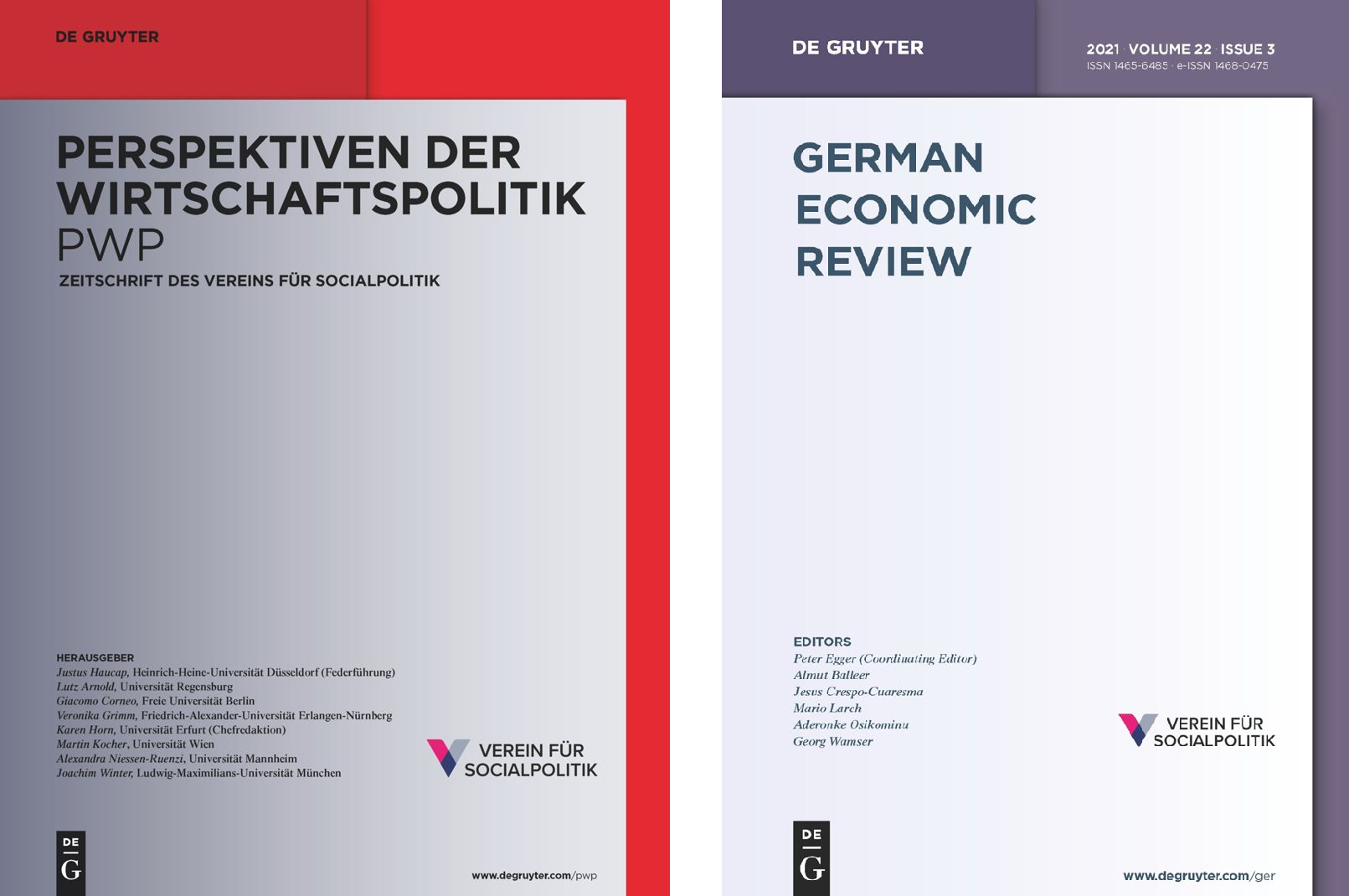
One of the main priorities during my term as Chair has been Open Access, a topic that will also be featured in a dedicated panel at this year’s Annual Conference. We have recently published a review article in Perspektiven der Wirtschaftspolitik that provides an overview of the key developments and challenges in this area. The article is available here (in German) as an Open Access publication.

My goal is to ensure that our two journals — Perspektiven der Wirtschaftspolitik and German Economic Review — remain freely accessible in the future, without article processing charges for authors and without subscription fees for readers. We are currently engaged in intensive discussions with several publishers to achieve this objective. I would like to express my special gratitude to ZBW – Leibniz Information Centre for Economics for its financial support through the OLEcon funding program which is helping us advance this important transformation process.

This year also saw the elections for the Executive Board and the Auditors. I would like to sincerely thank all members who participated in the election and thereby contributed to the democratic governance of our Association. The election results will be announced at the Annual General Meeting on September 13, 2026, at the University of Innsbruck.

I very much look forward to engaging conversations, stimulating scientific discussions, and seeing many of you again in Innsbruck.

With kind regards,

Klaus M. Schmidt
Chair of the Verein für Socialpolitik

From the Association

VfS Standing Field Committees

During the past six months, the regular rotation of chairs took place in several of the Verein für Socialpolitik’s Standing Committees.

The newly elected committee chairs are:

  • Standing Field Committee on Health Economics: Annika Herr
  • Standing Field Committee on History of Economic Thought: Elisabeth Allgoewer 
  • Standing Field Committee on Environmental and Resource Economics: Beat Hintermann
  • Standing Field Committee on Economic History: Carsten Burhop

Our sincere thanks go to the outgoing committee chairs for their dedication and service.

Career Advancement for Women
Doris Weichselbaumer

Diversity thrives through exchange. We are therefore delighted to once again offer a varied Gender and Diversity Program as part of this year’s VfS Annual Conference, creating opportunities for networking, new perspectives, and personal development.

Our well-established Mentoring Workshop for Women (Sunday, September 13, 12:30–2:30 p.m.) is designed for early-career female researchers and provides an opportunity to exchange ideas with experienced academics on research strategies, career paths, and balancing professional and personal life.

New to this year’s program is the workshop Online Hate, Real Impact: Protecting Women in Research (Tuesday, September 15, 11:00 a.m.–12:30 p.m.), led by Karoline Wodara. The workshop explores online abuse directed at women researchers and its impact on visibility, career progression, and well-being. Through expert insights, case studies, and interactive activities, participants will gain practical strategies for protecting themselves against online harassment and responding professionally to digital attacks.

The Women’s Networking Lunch (Tuesday, September 15, 12:30 –2:00 p.m.) that follows offers an opportunity to connect with colleagues and expand professional networks in an informal setting.

1st Generation Academics (Wednesday, September 16, 2:00–4:00 p.m.) focuses on social barriers in economics and strategies for overcoming them.

If you would like to participate in one or more of these workshops, please register when completing your conference registration. I wish us all an inspiring Annual Conference and look forward to seeing you in Innsbruck.

Doris Weichselbaumer
VfS Equal Opportunities Officer 

Fostering Young Talents
Arne Uhlendorff

Supporting the next generation of economists is one of the Association’s core priorities. One example is our Conference Subsidy Program, which helps early-career researchers present their work at leading international conferences. Applications for funding are open until October 31, 2026.

At this year’s Annual Conference in Innsbruck, we are once again offering events specifically designed for early-career economists. In the Job Market Preparation Seminar, which I am organizing together with Lena Janys (University of Konstanz) and Georg Dürnecker (Goethe University Frankfurt), participants will receive practical training to prepare for the academic job market. The program includes sessions on delivering an effective elevator pitch, participating in mock interviews, and developing compelling job talks.

Applications are open to all Association members eligible for the reduced membership fee until July 15, 2026. Applicants will be notified by August 4. The seminar itself will take place in Innsbruck on September 14 and 15.

Arne Uhlendorff
Commissioner for Career Development 

Research Data
FD

Research Data Committee

Since 2022, the Verein für Socialpolitik has been advocating for improved access to research data and supporting the federal government’s efforts to introduce a Research Data Act (FDG). The coalition agreement of May 2025 promised: „We (…) will introduce a Research Data Act before the end of this year“. In fact, an initial draft bill for the FDG was presented on December 22, 2025. The Verein für Socialpolitik submitted its own statement on this as part of the consultation with interest groups and in close coordination with the German Data Forum (RatSWD).

Since then, the BMFTR has been reviewing the more than 100 statements submitted, and worked on aspects of the draft bill that were initially missing or contentious. The Verein’s committee is in close contact with various stakeholders on this matter. A key priority for the committee is to work toward relaxing the legally mandated data deletion requirements in order to preserve researchers’ access to older data. Furthermore, the committee aims to bridge the gap between the provisions of the Research Data Act (FDG) and access to health data. There is hope for substantial progress on data access in both areas, and it would be unfortunate if the provision of health data in Germany were planned solely in view of the European Health Data Space, but not with regard to linkability within the framework of the Research Data Act.

Regina T. Riphahn
Chair of the Committee for Research Data

Schmölders Foundation Award

Pareto-Improving Tax Reforms and the Earned Income Tax Credit. The prize, endowed with €3,000, was presented to Emanuel Hansen by the Public Finance Committee of the Verein für Socialpolitik on April 24, 2026.

With this paper, the three authors make a landmark contribution to modern public finance. They develop a novel theoretical framework for identifying tax reforms that constitute a Pareto improvement—that is, reforms that make at least one individual better off without making anyone else worse off. For the first time, they derive necessary and sufficient conditions for the existence of such reforms and summarize their central insight in the concise statement: „Two brackets are enough“.

The framework is applied to the introduction of the Earned Income Tax Credit (EITC) in the United States in 1975. Their analysis shows that the pre-reform tax system was not Pareto efficient, while the specific design of the EITC itself did not constitute a Pareto improvement. At the same time, the authors demonstrate that a more broadly designed earned income tax credit could indeed have had the potential to achieve a genuine Pareto improvement.

Beyond this specific application, the proposed framework opens up a wide range of new possibilities for analyzing tax and transfer systems, providing an important stimulus for future research in public finance.

We warmly congratulate Felix J. Bierbrauer, Pierre C. Boyer, and Emanuel Hansen on this well-deserved distinction.

Association Journals
GER und PWP

Perspektiven der Wirtschaftspolitik

Dear Readers,

With our upcoming Annual Conference in Innsbruck in mind, this summer’s issue of Perspektiven der Wirtschaftspolitik (PWP) features the special issue Behavioral Economics in Economic Policy. My sincere thanks go to the guest editors, Sabrina Artinger (Federal Ministry for Digital Affairs and State Modernization) and Axel Ockenfels (University of Cologne/Max Planck Institute for Research on Collective Goods), for their outstanding work in putting together this issue.

The special issue offers fascinating insights into current behavioral economics research with direct relevance for economic policy. It demonstrates how behavioral insights can enrich policymaking in Germany and Europe and highlights their potential to foster effective, citizen-centered government.

Another special issue is already in preparation: a second PWP special issue on Evidence-Based Education Policy: Perspectives from the Economics of Education is planned for 2027. The Call for Papers can be found below. The guest editors will be Kerstin Schneider (University of Wuppertal) and C. Katharina Spieß (Federal Institute for Population Research).

You can also stay up to date with the latest news from Perspektiven der Wirtschaftspolitik on LinkedIn and X. We invite you to follow us and stay connected.

Achim Wambach
Editor-in-Chief

German Economic Review

Dear Readers,

The transition of our two Association journals to Open Access in 2025 marked an important milestone. Since then, all articles have been freely accessible worldwide—without paywalls—making them readily available to researchers, students, and anyone with an interest in economic policy. This broader accessibility enhances the visibility of published research and makes the journals an even more attractive venue for submissions. We are committed to continuing along this path.

Another key priority is safeguarding scientific quality in the age of generative AI. Going forward, authors will be required to accept De Gruyter Brill’s AI Guidelines when submitting their manuscripts. These guidelines promote transparency in the use of AI-assisted tools and help ensure the scientific integrity and high quality of the research we publish.

My sincere thanks go to all our Associate Editors for their outstanding commitment. I would also like to thank the wider academic community for its continued support—through the submission of high-quality manuscripts, thoughtful and constructive peer reviews, and the recognition of published research through citations.

The transition to Open Access has made the German Economic Review an even more attractive publication outlet. I warmly encourage you to submit your research to the journal and take advantage of the increased international visibility it offers.

Hartmut Egger
Editor-in-Chief

Dates and Press
KT 2026

VfS Annual Conference 2026 in Innsbruck – Where Academic Excellence Meets Alpine Charm

From September 13 to 16, 2026, the Verein für Socialpolitik will hold its Annual Conference at the University of Innsbruck. This year’s main conference on Behavioral Economics promises an outstanding scientific program. Highlights include keynote lectures by Matthew Rabin (Harvard University), Ulrike Malmendier (University of California, Berkeley), and Lucia A. Reisch (Cambridge Judge Business School), as well as a distinguished panel discussion featuring Martin Kocher (University of Vienna) and Ernst Fehr (University of Zurich). Together, they will explore how insights from behavioral economics are reshaping business, public policy, and society.

The Fascination of Economics  introduces high school students to economics and is aimed at inspiring the next generation of economists.

With its historic Old Town, spectacular Alpine scenery, and renowned Tyrolean hospitality Innsbruck itself is reason enough to attend. Whether strolling through the medieval city center, taking the cable car up the Nordkette mountain range, or enjoying an evening in the Alps, the city offers a unique combination of academic exchange, natural beauty, and cultural heritage.

Take this opportunity to gain fresh academic insights, expand your professional network, and spend a few late-summer days in one of the most beautiful cities in the Alps. We look forward to welcoming you to Innsbruck!

GA

Save the Date

The next General Assembly of the Verein für Socialpolitik will take place in Innsbruck on Sunday, September 13, 2026, from 5:30 to 6:30 p.m. Please save the date in your calendar.
Among other items, the agenda will include the announcement of the results of this year’s elections for the Executive Board and the Auditors. All Association members will receive a separate invitation, together with the meeting agenda, well in advance of the General Assembly.

Further Initiatives
RatSWD

RatSWD Election

The results of the RatSWD election (2026–2029) have been announced. The candidates nominated by the Verein für Socialpolitik, Kathrine von Graevenitz (University of Mannheim) and Hendrik Jürges (University of Wuppertal), have been elected to the German Data Forum (RatSWD) for its 9th term of office (2026–2029). The election results were announced on March 30, 2026, and the new term began on July 1, 2026. A total of 22 candidates, nominated by the professional associations of the social, behavioral, educational, and economic sciences, stood for election. Of the 3,080 registered researchers eligible to vote, 85.6 percent participated in the election.

The German Data Forum (RatSWD) is an advisory body to the German Federal Government. It advises the federal and state governments on matters relating to the research data infrastructure for the empirical social, behavioral, and economic sciences. The election of Kathrine von Graevenitz and Hendrik Jürges strengthens the visibility and representation of the Verein für Socialpolitik in one of Germany’s key science policy advisory bodies.

The Verein für Socialpolitik warmly congratulates both colleagues on their successful election and wishes them every success in their work on the German Data Forum.

Subscribe to our Job Alert and stay up to date with the latest academic job opportunities.

JT

To all our members—whether you have been part of the Verein für Socialpolitik for many years or have only recently joined us—thank you for being part of it. Your engagement and support is what makes our Association thrive.

If you have any questions, suggestions, or ideas, please don’t hesitate to get in touch with the VfS Office. We look forward to welcoming you to Innsbruck and seeing many of you there.

X
Linkedin
Bluesky